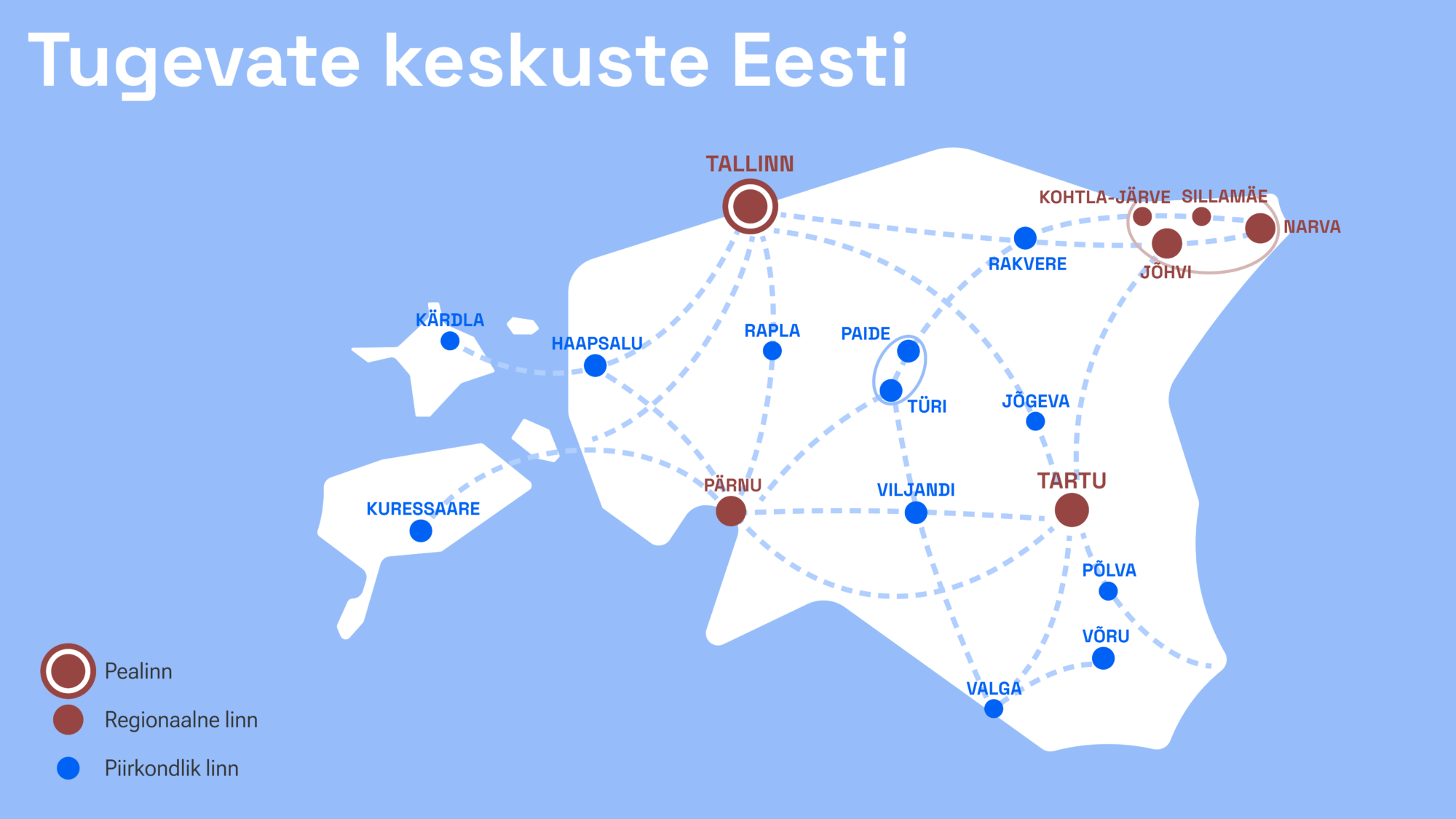
Since last week, a draft national plan has been open to public consultation, planning Estonia's spatial development for the next 25 years. The vision of the plan is to support development through strong centres across Estonia.
„We can see that people really want to live everywhere in Estonia and we have to make this possible. We are not just a country of three cities,“ said Minister of Economy and Industry Erkki Keldo. “The main aim of the plan is to improve the distribution of opportunities for self-fulfilment - to give people in different parts of Estonia the confidence that jobs, basic services, connections and a good living environment are available and will be maintained. The state's priority is an Estonia with strong centres that will continue to provide everything needed for life in 2050.”
This can be influenced by settlement patterns and careful land use, he said. „National planning does not say how wide the road is or which house goes where, but it does give principles on how to place them in a particular area. Residents can be sure that the development of their neighbourhood has a foundation on which to build public investment - roads, buildings, industrial sites, etc.,“ the minister explained.
The aim of the plan is to achieve balanced spatial development that will curb the current self-perpetuating urban sprawl, where Tallinn is growing and its periphery is shrinking. Researchers predict that, if current trends continue, the population of most municipalities would be reduced by a quarter or half by 2050.
According to Ivan Sergeyev, Deputy Undersecretary for Planning at the Ministry, the national plan is a lever for guiding spatial development, as it is the basis for all other planning in both the public and private sectors. „Country-wide planning is a roadmap that sets out common principles to ensure that well thought-out spatial decisions and development take place in the regions.“
The planning solution focuses on historically established and economically strong centres across Estonia. „It is important to focus on centres that have the strength to pull smaller places along. This is potential - leverage that can be exploited,“ Sergeyev pointed out.
„Times have changed, people's lives and activities are no longer confined to a single village or municipality. But all the necessities of life could be available in their own neighbourhood. Strong centres, together with surrounding settlements, could provide this.“
Check out the plan: www.riigiplaneering.ee/yrp
The national plan „Estonia 2050″ and its impact assessment report will be on public display until 31 March, when everyone will have the opportunity to consult the documents and express their views. Suggestions are particularly welcome to help develop the solution further.
Interested parties are also invited to the public consultation in the spring. More information: www.riigiplaneering.ee/sundmused