
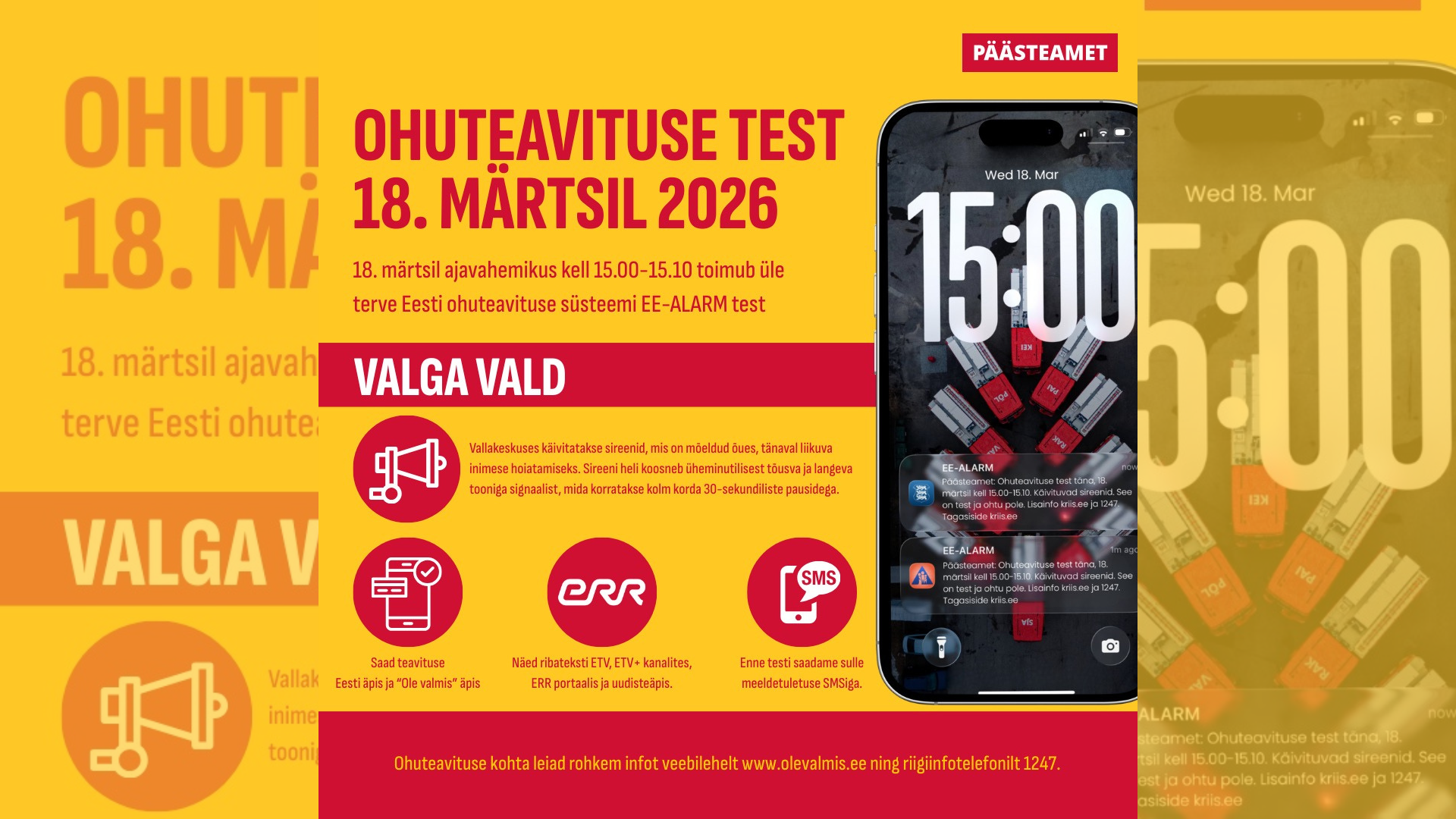
Over the past four years, Estonia has developed a national alert system, EE-ALARM, which sends rapid and immediate alerts to the population in the event of an emergency. The notification system is constantly evolving to keep pace with changing circumstances and opportunities. In order to ensure that the system works properly and that potential bottlenecks are detected in time, the Rescue Service regularly tests EE-ALARM.
The next test will take place on 18 March 2026. On the day of the test, an SMS will be sent to mobile phones with advance notice of the test.
On the same day, between 15.00 and 15.10, notifications will be sent to the Estonian app and the „Get ready!“ message. mobile apps, while at the same time you will see a bar text about the alert test on the ERR channels ETV, ETV+, the ERR.ee website and the „ERR News“ app.
Sirens will also be triggered. The sirens will warn people of the danger on the city streets. The sirens may not be audible indoors as this depends on various factors: the soundproofing of the building, the weather conditions, the location of the sirens, etc.
The siren test is available in Ahtme, Haapsalu, Jõgeva, Jõhvi, Keila, Kohtla-Järve, Kuressaare, Kärdla, Maardu, Narva, Paide, Paldiski, Pärnu, Põlva, Rakvere, Rapla, Sillamäe, Tallinn and its surrounding densely populated areas (including Tabasalu, Harkujärve area, Saue and Laagri, Peetri alevik, Saku, Viimsi municipality), Tapa, Tartu, Valga, Viljandi, Võru streets during the test.
In the next few years, cell broadcast technology will also be added to the alert system, which will allow an alert to be sent using sound, vibration and light, regardless of whether these settings are switched on or off in the phone.
Before the day of the test, please tell your loved ones, especially children and the elderly, that there is no real risk on the day and that it is a test.
To receive alerts via mobile apps, download the Estonia app or „Be prepared!“. mobile app and also enable notifications in the app. EE-ALARM will always be the sender of both the alert and the SMS.
For more information on the EE-ALARM alert system, visit the website www.olevalmis.ee
In addition to the March test, the nationwide alert will also be tested on 10 June and 14 October this year.
*** ENG ***
The nationwide public warning test takes place on March 18, 2026!
Over the past four years, Estonia has developed the national public warning system EE-ALARM, through which alerts are sent to the population in the event of danger. The warning system is under continual development to keep pace with changing circumstances and technological possibilities. To ensure that the system functions flawlessly and that potential shortcomings are identified in good time, the Rescue Service conducts regular tests of EE-ALARM.
The next test will take place on March 18, 2026. On the day of the test, a pre-information SMS will be sent to mobile phones, notifying users about the upcoming exercise.
Between 15:00 and 15:10 on the same day, notifications will be sent via the Eesti app and the “Be prepared!” mobile application. At the same time, you will see a ticker message on ERR's TV channels (ETV, ETV+), on the ERR.ee website, and in the “ERR News” app informing you about the test.
Sirens will also be activated. Sirens are intended to warn people who are outdoors on the streets. They may not be heard indoors, as this depends on several factors: the soundproofing of the building, weather conditions, the location of the sirens, and more.
The siren test will be audible in the following locations:
Ahtme, Haapsalu, Jõgeva, Jõhvi, Keila, Kohtla-Järve, Kuressaare, Kärdla, Maardu, Narva, Paide, Paldiski, Pärnu, Põlva, Rakvere, Rapla, Sillamäe, Tallinn and its surrounding densely populated areas (including Tabasalu, Harkujärve, Saue, Laagri, Peetri, Saku, Viimsi), as well as Tapa, Tartu, Valga, Viljandi and Võru. People who are outdoors in these areas during the test will hear the sirens.
In the coming years, the public warning system will also be supplemented with flash alerts (cell broadcast technology), which enables alerts to be sent using sound, vibration and light, regardless of whether these settings are switched on or off on a user's phone.
Before the test day, please speak with your family members - especially children and the elderly - and explain that there is no real danger and the event is only a test.
To receive public warnings via mobile applications, download the Eesti app or the “Be prepared!” Both app notifications and SMS messages are always sent by EE-ALARM.
More detailed information about the EE-ALARM public warning system is available at www.olevalmis.ee
In addition to the March test, the nationwide public warning system will also be tested this year on June 10 and October 14.
*** RU ***
The national test of the hazard warning system will take place on 18 March 2026!
In Estonia, the EE-ALARM system has been set up over the last four years to provide rapid and rapid notification to the public in the event of a threat. The system is constantly evolving to meet changing conditions and new opportunities. The Rescue Department carries out regular testing of EE-ALARM to ensure that it works reliably and to identify possible shortcomings in a timely manner.
The next test will take place on 18 March 2026. On that day, an SMS will be sent to mobile phones with advance information about the test.
On the same day, from 15:00 to 15:10, notifications will be sent to the mobile apps Eesti Äpp and «Be prepared!». At the same time, a ticker will appear on the ERR channels - ETV, ETV+, on the ERR.ee website and in the «ERR News» app with a message about the test.
Sirens will also be switched on. These are intended to warn people on city streets. Indoors, the sound may not be audible - this depends on the soundproofing of the building, the weather, the location of the sirens and other factors.
During the test, sirens will be heard by residents and people in the streets in Ahtme, Haapsalu, Jõgeva, Jõhvi, Keila, Kohtla-Järve, Kuressaare, Kärdla, Maardu, Narva, Paide, Paldiski, Pärnu, Põlva, Rakvere and Rapla, Sillamae, Tallinn and the surrounding densely populated areas (including Tabasala, Harkujärvi district, Saue and Laagri, Peetri settlement, Saka, Viimsi municipality), as well as in Tapa, Tartu, Valga, Viljandi and Võru.
In the coming years, cell broadcast instant messaging technology will be added to the system, which will allow notifications to be sent using sound, vibration and the phone's backlight, regardless of the device settings.
Before the test day, please talk to your loved ones - especially children and the elderly - and explain that there is no real danger on the day and that only the system is being checked.
To receive alerts via mobile apps, install the Eesti Äpp or «Be prepared!» apps. and enable notifications. EE-ALARM is always the sender in both apps and SMS.
Detailed information on the EE-ALARM notification system is available at www.olevalmis.ee
In addition to the test in March, this year's national warning system will also be tested on 10 June and 14 October.