Safety awareness tests are not just a technical check, but an opportunity to practice and consolidate knowledge that can save lives. On Wednesday 18 March, the third nationwide EE-ALARM test will take place, with the launch of sirens. Over the last few years, Estonia has built up a completely new system of hazard warning, which needs constant monitoring and development to be fully operational when it is needed most. Now that people are gradually getting used to the idea that such tests are taking place, we also need to talk more and more about how to respond to an alert in a real emergency.
When a country triggers the sirens, it absolutely always means one thing: shelter in the nearest indoor area. While hazard warning messages always include instructions on how to behave, sirens do not convey such information and it is up to each individual to know what to do. When you hear a siren or receive a shelter-in-place message from EE-ALARM, go immediately to the nearest indoor area, as low as possible to the ground floor, to a room with solid walls and away from windows.
There may not always be an ideal solution in a security situation and we need to find the best possible solution in the existing environment. The general advice is to go to the basement, but if not, stay as low as possible and use other safer rooms. It is important to stay away from windows, to stay indoors where there are at least two solid walls between you and the outside, etc.: bathrooms, toilets, stairwells are often such spaces. There are different solutions and some offer better protection than others. If there is no other option, it helps to have some thick curtains over the windows. The fact is, however, that there is a much greater risk of being hit by something outside the building in the event of an explosion. Remember that any barrier between you and the threat can save you from serious injury or death.
If you're outdoors and there's no indoor space nearby, don't just stand under the overcast sky in case of an explosion. The best way to protect yourself at this point is to lie down in a ditch or ditch and cover your head with your hands. The most dangerous thing to do is to remain upright and visible. Taking cover means reducing your vulnerability - any obstacle between you and the danger can save you from serious injury. In the event of an explosion, the most dangerous thing is the fragments and objects that can be thrown at dangerous speeds as a result. You should therefore keep as close to the ground as possible.
Experience in Ukraine shows that in a war situation, the upper floors of buildings or the whole side of a building can often be badly damaged, but the structure still holds and people have managed to shelter safely on the lower floors. Adapting the basement or lower rooms (e.g. by supporting the ceiling or walls) to ensure that the room will survive a collapse is also a major contribution. Unfortunately, being outdoors in a sheltered environment makes you many times more likely to be seriously injured or killed.
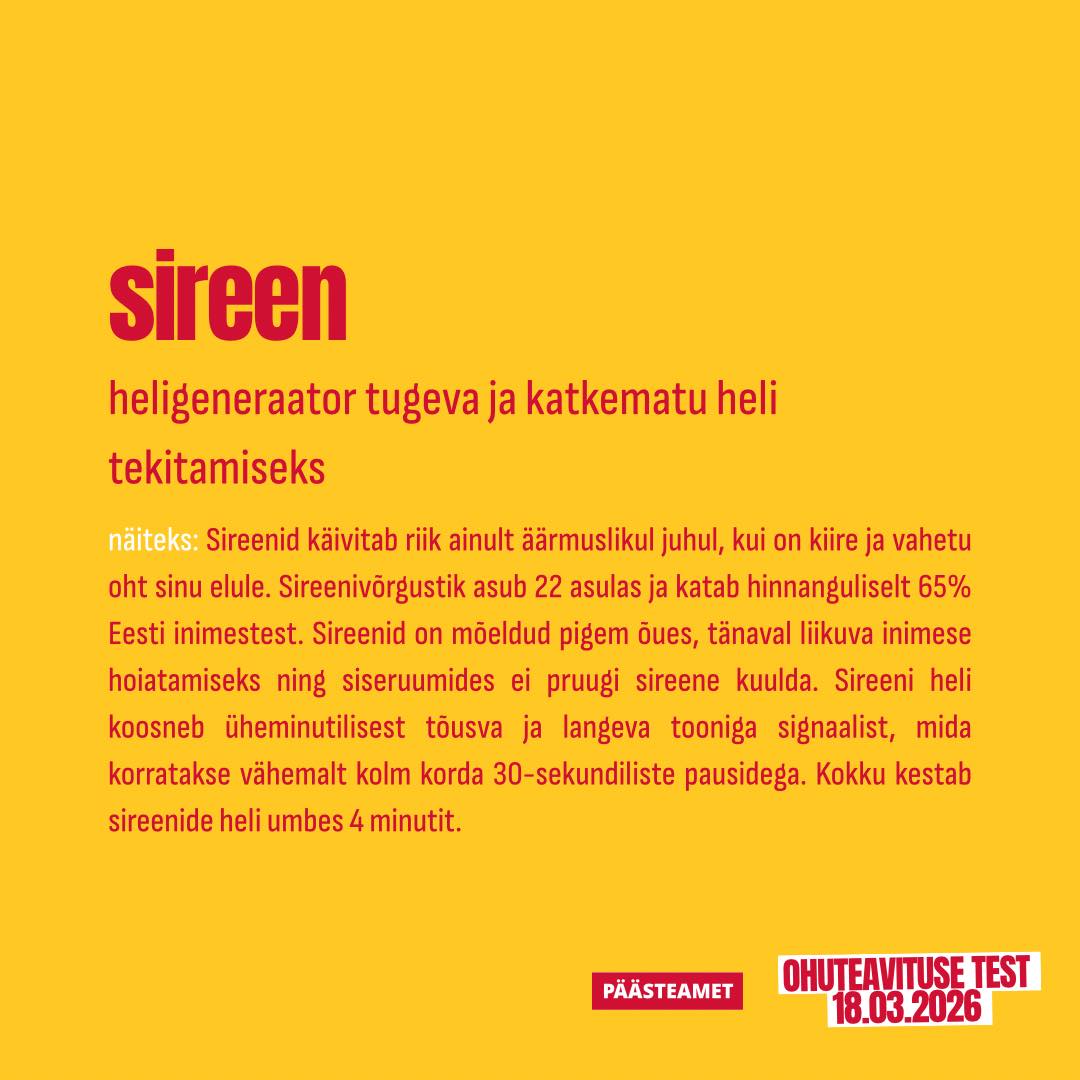
There has been a lot of research from the emergency services on how a person can know of a danger if they do not hear a siren. Sirens are only one part of the national warning system and are used in Estonia's largest settlements. The sirens are there to warn people of danger on the streets. They may not be audible indoors, as this depends on various factors: the soundproofing of the building, the weather conditions, the location of the sirens, etc. The sirens are used to warn people of the presence of sirens. Otherwise, the warning will have to reach people through other channels, such as SMS, the Estonian app and „Be prepared“. mobile apps and in the form of bar texts on the ERR channels ETV, ETV+, the ERR.ee portal and the news app. By 2027, it is also planned to develop the cell broadcast, which allows you to send an alert instantaneously and, depending on the level of risk, to have the phone alert you with sound and light even when it is in silent mode.
More information:
The Rescue Board will test the EE-ALARM system three times in 2026:
- 18 March
- 10 June
- 14 October
On these dates, all alert channels, including sirens, will be activated.
- Around noon, a text message (SMS) will be sent to mobile phones with advance notice of the test.
- Between 15.00-15.10
- sirens are triggered,
- notifications will be sent via the Estonia app and „Get ready!“. mobile app,
- see the ERR channels (ETV, ETV+, the ERR.ee website and the ERR News app) for a banded text about the risk warning test.
Viktor Saaremets, Deputy Director General, Rettemet